We would like to thank the Weber County Sheriff's Office for providing these records and maintaining a culture of transparency throughout this process.
Nothing on this page is a criticism of that office, its personnel, or their integrity. Weber County did not design this platform, did not write its sharing defaults, and did not create the gap in Utah law that leaves no agency able to verify how others use the data it shares. Every finding here should be assumed to describe the situation at agencies across the state. The difference is that Weber County is the only one that has let anyone look.
The Numbers
What Utah Law Requires
Utah is not a state without rules here. It has had an Automatic License Plate Reader System Act since 2013, amended in 2023. This is what it says.
The default is that you may not use these systems at all
"Except as provided in Subsection (2), a governmental entity may not use an automatic license plate reader system."
— Utah Code § 41-6a-2003(1)
There are four exceptions, and only four
"an automatic license plate reader system may be used... by a law enforcement agency to access captured license plate data:
— § 41-6a-2003(2)(a)
(i) as part of an active criminal investigation;
(ii) to apprehend an individual with an outstanding warrant;
(iii) to locate a missing or endangered person; or
(iv) to locate a stolen vehicle"
The first exception is not open-ended. The statute defines it:
"'Active criminal investigation' means an officer has documented reasonable suspicion that a crime is being or has been committed, and believes the suspected criminal activity may be connected to a vehicle, a registered owner of a vehicle, or an occupant of a vehicle."
— § 41-6a-2002(1)
The data may not be used or shared for anything else
"Captured plate data obtained for the purposes described in Section 41-6a-2003... may not be used or shared for any purpose other than the purposes described in Section 41-6a-2003."
— § 41-6a-2004(1)(b)
"A governmental entity that is authorized to use an automatic license plate reader system under this part may not share or use captured plate data for a purpose not authorized under Subsection 41-6a-2003(2)."
— § 41-6a-2004(2)(b)
Every search must be recorded, and kept for five years
"(a) A law enforcement agency shall preserve a record of:
— § 41-6a-2005(6)
(i) the number of times a search of captured license plate data is conducted by the agency or the agency's employees or agents; and
(ii) the crime type and incident number associated with each search of captured license plate data.
(b) A law enforcement agency shall preserve a record identified in Subsection (6)(a) for at least five years."
Using these systems at all requires a policy that covers auditing
"A law enforcement agency may not use an automatic license plate reader system unless... the law enforcement agency has a written policy regarding the use, management, and auditing of the automatic license plate reader system."
— § 41-6a-2003(3)(a)
Misuse is a crime
"A person who knowingly or intentionally uses, obtains, or discloses captured license plate data in violation of this part is guilty of a class B misdemeanor."
— § 41-6a-2006
What the Records Show
Asked in writing for any audit, compliance review, or self-assessment of the system, the Weber County Sheriff's Office responded on August 6, 2026:
"This is not a record that we maintain."
Weber County Sheriff's Office, August 6, 2026After this investigation was published, the Sheriff's Office clarified the record for us in writing. Audits of the network were performed, but no log of them was kept — which is why the county's written response reported that no audit records exist. The office has since created a form to log network audits going forward.
That account reconciles cleanly, and it does not change the finding. A review that leaves no record behind cannot be examined by anyone afterward, and it is not a verification mechanism. The new form applies only going forward; it produces nothing for February 2022 through July 2026, and that gap is permanent.
The depth of those audits is also not yet known, and it matters. This network logged roughly 230,000 searches a month in 2026. Examining even one percent would mean reviewing some 2,300 searches every month, and reviewing a search is not the same as verifying one. Verification would mean contacting the agency that ran it, in another state, and confirming that a real case sits behind the reason typed into the box. No sheriff's office in Utah is staffed to do that at scale, and it would be unreasonable to expect one to be.
We are glad someone is looking. But a spot check of a national network is not verification of it, and the jurisdictional gap stays open until closing it is someone's actual job rather than one agency's goodwill.
We note that the office answered the question directly, acknowledged the gap, and corrected the process within days of being asked. That is the response we would want from any agency.
Network access is granted per agency, not per search. Once an agency is approved, its officers query directly, and no one at the county reviews the searches.
There is no mechanism available to Utah law enforcement to verify whether other agencies are following Utah's license plate reader law.
The statute sets a requirement that no administrative apparatus was ever built to carry out. Utah requires each search to be logged with a crime type and incident number, and requires those logs to be kept for five years, but no office collects them, no format is specified, and no agency reports them to anyone. Whether the requirement is being met is left to each agency to determine for itself, and whatever it determines stays with that agency.
County and municipal law enforcement budgets are already tight. An audit that no office collects, no one reviews, and no one asks for competes for the same hours as calls for service. Where a requirement goes unchecked and unprioritized, the incentives around it are misaligned, and it goes unperformed. That is a predictable structural outcome, not a failure of any one agency.
That infrastructure does not exist inside Utah, for Utah's own agencies. It certainly does not exist for the 3,343 agencies across 45 states that have searched this network. Meaningful accountability would mean auditing every one of them, and no authority in Utah has the power or the tools to do that.
The Core Finding
2,141,406 searches, 41.4% of the total, carry a stated reason that matches no purpose Utah law permits.
Every improvement in this record tracks a vendor product release rather than a county policy change. A case-number field first appears in February 2025. A structured reason menu rolled out in mid-2025.
What the County Actually Owns
A subscription. Not much else.
| Item | Does the county own it? |
|---|---|
| The cameras | No. Title never passes to the county, and it may not remove, reposition, or take possession of them. |
| The images | No. The contract excludes raw footage from what the county owns. |
| Anything derived from the images | No. All derivative outputs, analyses, and models belong to the vendor, and the county has no right to export them. |
| A deletion guarantee | The 30-day retention limit applies only to the data the county does own. Nothing commits the vendor to deleting the footage or the derivatives. |
Accounts belonging to the vendor itself ran 179 searches of Weber County's data, including 78 by an account named Flock Safety - Sales.
Surveillance as a Service
Local agencies are not building surveillance systems. They are subscribing to them. The capability is rented, the hardware is rented, and what a county buys for its annual fee is a seat in a national network it does not control.
This Is Not a Weber County Story
Weber County released the records. It granted a fee waiver, answered eleven categories of request, and put an official on the phone with us. It is the only agency in Utah that has let anyone look.
The settings that produced this network are standard product features, documented in the vendor's own training materials obtained by the ACLU of Massachusetts in October 2025.
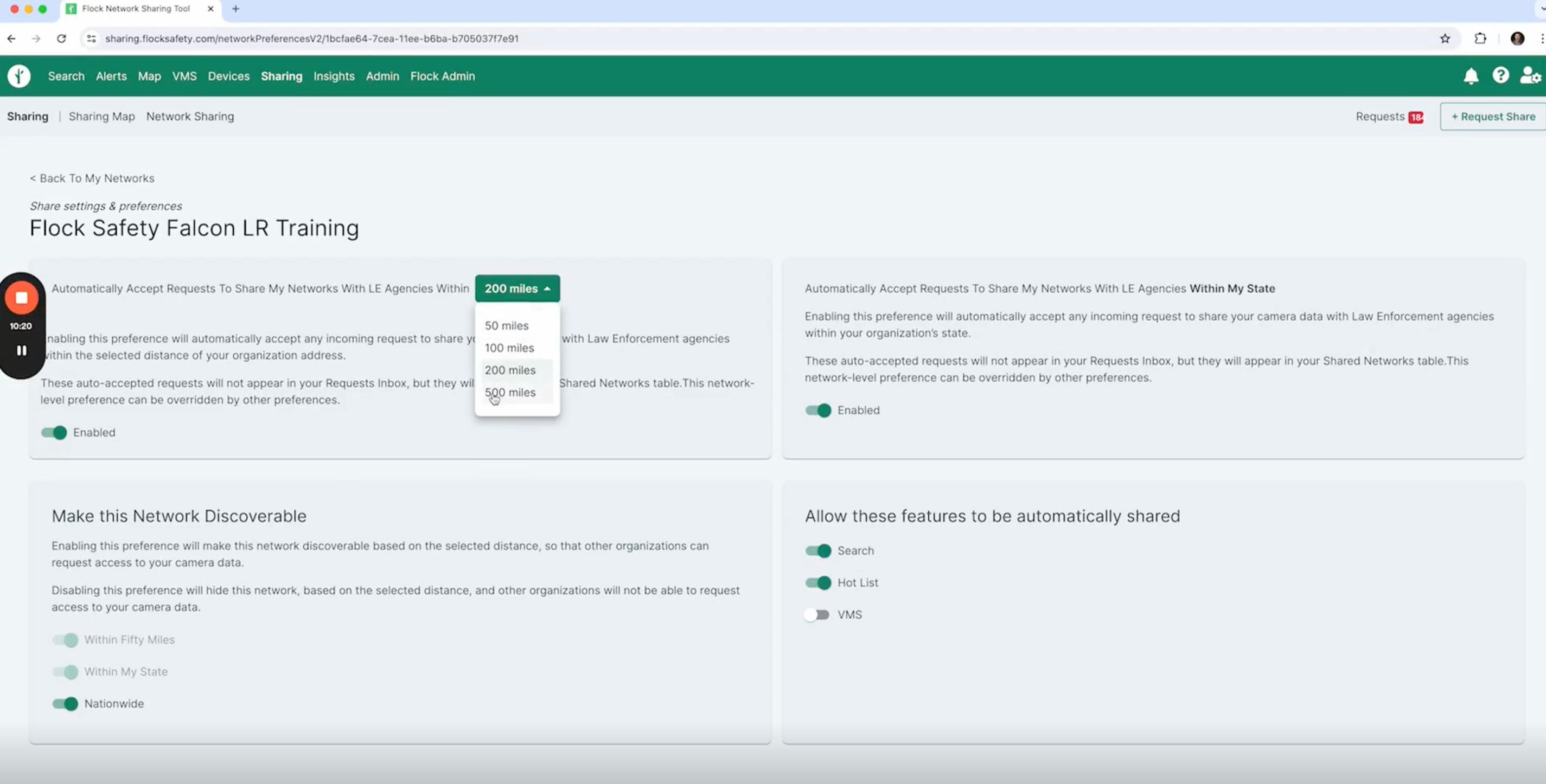
Every finding on this page is a question that should be asked of every agency in the state.
What We Are Not Claiming
- Not that any of these searches was unlawful. Utah requires a record of the crime type and incident number, but does not require it to live inside the vendor's software. An officer who typed inv may hold a full investigative file elsewhere. What the records establish is that for 41.4% of searches, no authorized purpose is documented in any record available to the agency that shared the data.
- Not that out-of-state agencies broke Utah law. Whether Utah's statute reaches them is an open question.
- Not that Weber County acted in bad faith.
- Not that out-of-state agencies targeted Utah. Agencies running broad multi-network searches reach these cameras automatically. That is the design, and that is the point.
One caveat on the totals. The 3,343-agency and 45-state figures depend heavily on 2022 and 2023, which contributed 1,993 and 3,078 agencies before a cutoff in December 2023. After it, annual agency counts are 40, 227, and 245. The provenance of the earlier data has not been established. The 2026 figures, 245 agencies and 98.6% out-of-state, do not carry that uncertainty.
The Data
Everything is public. Nothing here is characterization; it is the records.
All of it lives in one archive at the Internet Archive — 209 MB, free, no account required. It contains:
- Every search record released by the county — 5,171,087 rows, February 2022 through July 2026, packaged by year
- The organization search export and the administrative event log
- The vendor order form and its terms and conditions
- The Sheriff's Office ALPR policy and the state highway permit application
- The records requests, the county's written responses, and the two denials
- A README with the data dictionary, parsing notes, and a statement of what was redacted and why
Top 50 requesting agencies, 2026
1,608,828 searches across 245 agencies, January through July. A partial year — the production ends with the July 2026 file — so these figures cover seven months rather than twelve. Even so, 2026 is already the largest year in the production. The top 50 agencies account for 85.6% of all searches. The Weber County Sheriff's Office does not appear on this list; it ranks 159th of 245 on its own network.
| Rank | Agency | Searches | % of year |
|---|---|---|---|
| #1 | Houston TX PD | 423,031 | 26.294% |
| #2 | Louisville Metro KY PD | 89,375 | 5.555% |
| #3 | Harris County TX SO | 89,308 | 5.551% |
| #4 | Hillsborough County FL SO | 83,889 | 5.214% |
| #5 | Palm Beach County FL SO | 53,017 | 3.295% |
| #6 | Missouri State Highway Patrol | 43,449 | 2.701% |
| #7 | Indiana State Police IN PD | 40,166 | 2.497% |
| #8 | Pennsylvania State PD | 31,432 | 1.954% |
| #9 | Richland County SC SO | 25,112 | 1.561% |
| #10 | [Federal] US Postal Inspection Service | 23,551 | 1.464% |
| #11 | Texas Department of Public Safety | 23,416 | 1.455% |
| #12 | Fairfax County VA PD | 22,137 | 1.376% |
| #13 | Lubbock TX PD | 22,051 | 1.371% |
| #14 | Tulsa County OK SO | 21,188 | 1.317% |
| #15 | Colorado State Patrol | 21,156 | 1.315% |
| #16 | Bloomington IL PD | 19,643 | 1.221% |
| #17 | Mississippi Department of Public Safety | 16,856 | 1.048% |
| #18 | Salinas CA PD | 16,586 | 1.031% |
| #19 | Sarasota FL PD | 16,542 | 1.028% |
| #20 | Murfreesboro TN PD | 16,083 | 1.000% |
| #21 | Raleigh NC PD | 16,063 | 0.998% |
| #22 | O'Fallon MO PD | 15,858 | 0.986% |
| #23 | Shelby County TN SO | 15,207 | 0.945% |
| #24 | Amarillo TX PD | 14,142 | 0.879% |
| #25 | St. Charles City MO PD | 13,579 | 0.844% |
| #26 | Fishers IN PD | 13,366 | 0.831% |
| #27 | Larimer County CO SO | 13,002 | 0.808% |
| #28 | Richmond VA PD | 12,527 | 0.779% |
| #29 | Peoria IL PD | 10,635 | 0.661% |
| #30 | Springfield MO PD | 10,134 | 0.630% |
| #31 | Jefferson County MO SO | 9,560 | 0.594% |
| #32 | Alabama Department of Corrections | 8,691 | 0.540% |
| #33 | Thornton CO PD | 8,594 | 0.534% |
| #34 | Panama City FL PD | 8,486 | 0.527% |
| #35 | Aurora CO PD | 8,414 | 0.523% |
| #36 | Wichita Falls TX PD | 8,164 | 0.507% |
| #37 | Sparks Police Department - NV | 8,069 | 0.502% |
| #38 | Washington County WI SO | 7,617 | 0.473% |
| #39 | Riverside County CA District Attorney | 7,437 | 0.462% |
| #40 | Little Rock AR PD | 7,209 | 0.448% |
| #41 | Jefferson County CO SO | 7,090 | 0.441% |
| #42 | Dearborn MI PD | 6,931 | 0.431% |
| #43 | Washoe County NV SO | 6,828 | 0.424% |
| #44 | Iredell County NC SO | 6,804 | 0.423% |
| #45 | Sterling Heights MI PD | 6,585 | 0.409% |
| #46 | Germantown TN PD | 6,322 | 0.393% |
| #47 | El Cajon CA PD | 5,923 | 0.368% |
| #48 | Vestavia Hills AL PD | 5,548 | 0.345% |
| #49 | Brighton CO PD | 5,517 | 0.343% |
| #50 | Hempstead Village NY PD | 5,512 | 0.343% |
| Top 50 subtotal | 1,377,802 | 85.640% | |
| Total, all 245 agencies | 1,608,828 | 100.000% |
Verify it yourself
The records requests that produced this are reproducible. The request language, the file numbers, and the county's responses are all in the archive above, so any resident or reporter can run the same request at any Utah agency.
What We Are Asking For
A legislative audit
Utah's Office of the Legislative Auditor General can audit any political subdivision and any organization that receives public funds. That reaches both the agencies and the vendors.
A verification mechanism
An agency sharing residents' location data should be able to find out whether the recipients are following Utah law. Today it cannot.
Disclosure
Every Utah agency operating these cameras should publish its current network sharing configuration. It is one screen.
Legislative action
Three ALPR reform bills have failed since 2025. HB0468 passed the House 64 to 2 and died on the final day of the session.
Join Us
Ask your legislator to request a legislative audit of license plate reader practices. Find your legislator →
You can pull your own network sharing configuration and your own audit records in an afternoon. We will help you read them, at no cost and without publishing anything you don't want published.
If your community is weighing these cameras, or reconsidering them, we will share the records requests, the analysis, and the questions that produced this work.
The complete dataset, every source document, and the methodology are yours. We will walk you through any of it.
Read About This in the Media
Utah newsrooms have reported on these records independently. Each link goes to the outlet’s own coverage.
Get in touch
Questions about the records, the methodology, or your own agency's configuration. We answer all of them.
Email info@utahciviccompact.orgUtah Civic Compact is a nonpartisan 501(c)(4) civic organization working on government transparency and accountability in Utah.